For the past three years I have been writing two very different novels, both of which I consider finished (although I have no doubt that a more objective reader could easily find ways to improve them). I am currently trying to find an agent for each of them. Writing is pleasurable for me. Imagining that someone will enjoy reading what I have written is even more pleasurable. In A.S. Byatt’s magnificent 1990 novel, Possession, the character Blanche Glover states, “Nothing endures for certain, but art endures for a time, and I have always wanted to be understood by those not yet born.” Me, also. In a similar expression we can turn to Hippocrates for: “Vita brevis, ars longa.” This is actually a misquote from the original Greek aphorism,. In its commonly used form, it continues “life is short, the art long, opportunity fleeting, experience treacherous, judgement difficult.” Hippocrates was talking about the art of medical practice while Blanche Glover’s comment is about the fine arts (e.g., poetry, prose, painting, sculpture, etc) as we know them today. And, yes, life is indeed all too brief. A cave painting in Indonesia, thought to be more than 50,000 years old, depicts three human figures around a wild pig. Some Sumerian writing, in cuneiform, is from 3400 to 3200 BCE. Ars is, decidedly, longa.
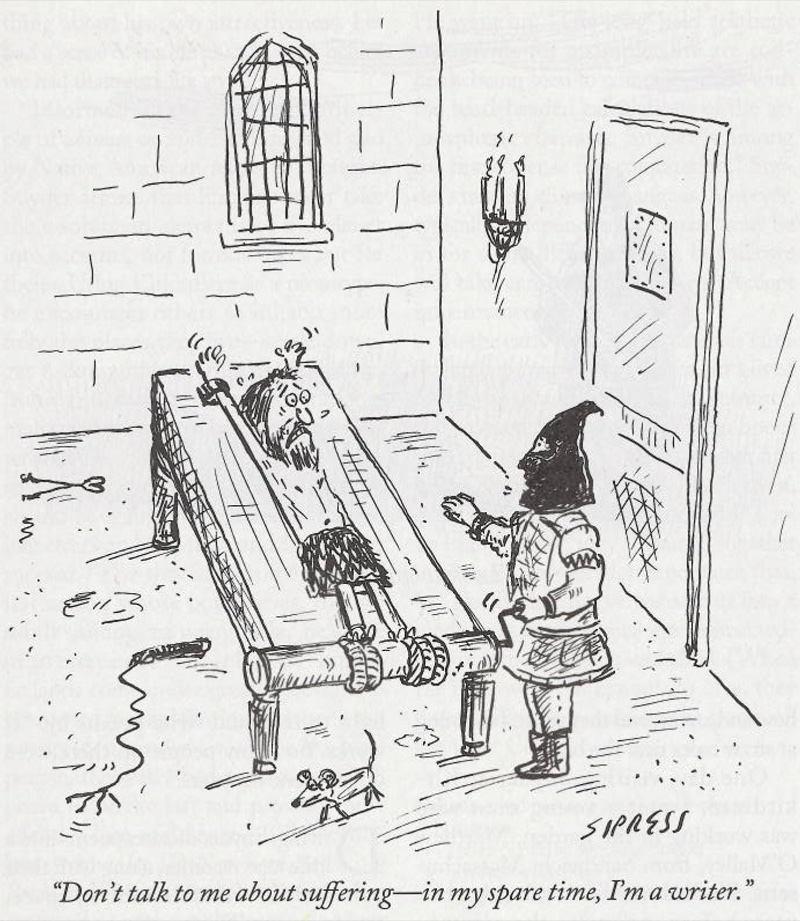
Publishing creative writing somewhere for others to read is, unfortunately, often painful. I’ve contributed to many scientific articles and book chapters that have been published, but I don’t recall that putting them together was terribly hard. I keep a copy of this old New Yorker magazine cartoon on my desktop, although I hardly need reminding that writing novels, short stories and essays is not easy:
The first novel I am trying to have published is Encores, a sequel to my first novel, A Little Piece of Me. It returns to the story of Marcia Whitman who, after struggling with her marriage, her career and the health of her little boy, finds herself on unfamiliar paths. She earns international acclaim as a pianist, while still grieving over the death of her little boy 10 years ago. A Little Piece of Me earned a number of laudatory reviews (e.g. “ … one of the finest books we have read in a long time.” – M.K. Turner for BookReview.com). Unfortunately, it did not sell very well, I did not understand, at that stage, how much effort authors need to invest in promoting their own books. Since then, I earned a Master of Fine Arts (MFA) in 2018 from the Vermont College of Fine Arts and, perhaps more importantly, began attending professional meetings for writers and reading magazines directed at writers (e.g. “Poets and Writers” and “Writers Digest)”. I also joined a variety of on-line organizations which regularly provide useful information for writers.
After all this, the cartoon is even more meaningful and valid. I have been fortunate to have seven short stories published and have another six awaiting some literary magazine to select for publication. Recently, I was informed that an essay of mine will be published.
Publishing short stories or essays is as challenging as publishing novels, but very different. Literary magazines receive submissions from far more contributors than they can handle. For a novel one generally submits a “query” letter to introduce the novel to agents asking them to represent that novel to publishers. Agents receive far too many query letters than they can handle. Usually, the agents specify how many pages—usually ten or twenty or fifty—they want to read. If the query letter is successful, the agent will ask to read the entire manuscript before agreeing to serve as the author’s agent. Non-fiction books, in contrast, don’t have to be complete before asking an agent to represent it; a proposal outline of the book usually suffices. Getting an agent to agree is a difficult and tedious task unless your name is Stephen King and not Stephen Geller.
The second novel in need of an agent is about a failed murder attempt on the protagonist, Bert Eliason, a retired pathologist (“write about what you know”). Taking place in Beverly Hills, Bert wonders if he is the luckiest man in the world or whether his luck is running out as he, the local police and the FBI try to figure out who would want him dead and why. The name of this book is Wrong Me.
The young assassin is himself killed in in a tussle with Bert when his revolver, squeezed between the two of them, fires. The assailant does not seem to have any connection with Bert and the Police, the FBI and Bert eventually come to understand that this probably was a case of mistaken identity.
In trying to find someone who looks like Bert, the FBI searches its facial identity data files as well as similar files available internationally. A match is not found but Bert is convinced his doppelganger exists and lives nearby. There are a number of twists and turns which I hope you will eventually have the opportunity to explore when this book is published.
One of the great pleasures of writing is, of course, reading new things to help in the writing. I have learned about so many people and so many things as I prepare each blog post. In my last post, discussing poetry and song lyrics, I had the chance to read about songwriters about whom I barely knew anything. I knew that Hammerstein had befriended Sondheim but I wasn’t aware they once lived close to each other. I didn’t know anything about Joe Darion, who penned the lyrics for “Man of La Mancha”. Doing the research also gave me excuses to again read some favorite poems. Indeed, the research is often at least as pleasurable as the writing (one of the things I’ve learned in my new career is that writing is hard work!) and far more pleasurable than the promoting.
In my research into the relatively new field of facial identification, I learned many things, including about “prosopagnosia” and its clinical counterpart, “super recognizers.”
Here is the section of my novel that discusses prosopagnosia. Bert Eliason is the retired pathologist who was almost murdered. Rodion Helm is the Beverly Hills Police detective who has become a friend and who has recently returned from a trip to London where he and other California police officers were sent to learn about facial identification hardware, especially closed-circuit television (CCTV), and software. Reza Gangi is the dead would-be killer.
“The state sent me and a lieutenant from Parker Center, and somebody from San Diego, somebody from San Fran and a couple of Sacramento people to learn more about it. There’s just so much you can get from reading. Stupid as it sounds, there’s just so much you can learn from the computer even about a topic like this. There’s still nothing quite like on-the-scene observation.” He tested the coffee with a quick sip to see if it was cool enough and followed with a longer sip. “That’s true for police work most of the time. You know?”
Bert nodded again.
“It might even be true for medicine,” Helm said. “For pathology.”
“Absolutely. You can’t learn as well from a book or a DVD as you can from the real thing. But I also think we won’t be learning the way we used to learn for much longer. Putting all the new tools together may prove to be at least as good as the old ways. Microscopes are on the way out.”
“You think so?”
Bert took another sip of the hot chocolate, no longer too hot, and asked, “So what did you learn?”
“A lot of things. Everything from how they decide where to place the cameras to how they maintain them to when they need to replace them. To how the bad guys can disable them. Not so easy, as it turns out.” He swiped the corner of his mouth with a napkin. “Who the best manufacturers are. There are a lot of manufacturers, including in the U.K. and the usual places. Germany. China, South Korea. More than a half dozen places in Europe. Even Southern California. Lots of places make them.”
“And how does this relate to me or, more to the point, to Reza Gangi?”
“I’m getting there, doc, trust me.”
“I trust you, Roddy. I do,” Bert smiled broadly, tilting his cup toward Helm, as if toasting him.
“It turns out there are about one million CCTV cameras in London, maybe more by now. That’s about one for every eight people. There are more cameras than you can even imagine. And more coming. When you go out for an evening stroll you can get your picture taken a dozen or more times and,” he looked directly in Bert’s eyes, “digitally stored. Lady Gaga doesn’t get that much attention.” Helm continued. “So, you would think that the facial recognition software is just clicking out the bad guys every minute. And, to a degree, it does. It works well and the combination of lots of images from all over London coupled with effective software to study all those images helps the police a lot. They don’t talk much about it, and try to keep it out of the press, but they’ve stopped several bad guys from doing really bad things. Bad guys with bombs.”
Now Helm sat back and, with a series of sips and longer slurps, finished his coffee. “And there are lots of companies pushing the software also. But all that stuff I might have learned in an email message.”
“I suppose.”
“Here’s the interesting part. Fascinating, actually.”
“Yes? What you’ve told me is already pretty interesting.”
“Wait. Listen to this.” He leaned across the table, his voice now a gravelly almost-whisper. “They also have a small group of police, a special unit, who do as well and maybe better than the software.” He paused, staring directly into Eliason’s eyes. “Without using one volt. One watt. One joule.”
Now Bert moved his chair forward a little, his brow wrinkled and his head tilting to the side. “I’m not following you.”
“Do you know about … hold on …” he pulled his cell phone out and opened one file and then another. “Do know about pro- … proso- … pagnosis … yes, that’s right, prosop-agnosis, prosopagnosia?”
“I haven’t the foggiest idea what that means.”
The familiar half-smile came to Helm’s face, his eyelids their usual half-mast position. “Apparently some people in the world, because of their genetics, have what is called ‘face blindness.’ They have some inherited defect and they can’t recognize faces. This is rare, but it’s likely that many others with the same defect, but less severe, are also around. There probably isn’t an on-off switch but gradations of the defect. Your bell curve distribution. Some people—they’re rare—just can’t recognize faces at all. Period. Never. Others are just very crummy at recognizing faces and still others are so-so.” He lowered his voice. “Now, here’s something to think about. It’s likely that some small percentage of security people at airports have this defect. Think about that one for a while. Sort of makes you want everything checked electronically, doesn’t it? Anyway, there are a couple of good tests for this—one is …” he looked back at his phone, “the Cambridge Face Memory Test—but, for lots of reasons, no one uses this test as a part of the application process in the real world. Anywhere. It’s possible, with the right set of circumstances, with the right guy with …” he checked the phone again, “with prosopagnosia, if he’s examining passports or what not–– the people themselves–– that somebody looking like Marilyn Monroe, or worse, Osama bin Laden, could get through without being recognized. If there weren’t other systems for checking.”
Bert didn’t say anything but his head kept bobbing as he considered what Helm was telling him and the implications.
“So, on the other hand, maybe the opposite is true,” Helm continued. “Maybe there are people who have an incredible gift to recognize faces. Much better than the software. As you know, the software isn’t perfect.” Now his voice was louder. “It’s fallible. Especially with young people. People of color. You know?” He leaned forward, now almost whispering. “Maybe some human beings have this genetic defect which—are all gene changes considered defects?—maybe some are really enhancements, gene enhancements. Anyway, some defects that are the opposite of whatchamacallit …” he again checked the phone, “of prosop- … prosopagnosia … maybe there’s something the exact opposite of that and, unlike facial recognition software, is for all intents and purposes close to infallible in the ability to recognize faces.”
Bert still did not respond. Then he cleared his throat and said, “You obviously know some people like that.”
“Here’s the thing, doc. The most interesting thing I saw there. Maybe the most important. The London police have a small unit in which there are a few people who seem to be exactly like that. They look at all those CCTV tapes and other things, newspapers, television news shows, thousands of images, and they can recognize faces that are missed by the software. Missed. They make matches of some face they see on the British Museum tape with the same face when it pops up on the Tower of London tape. You get it?”
“Okay.” Bert looked up at the lazily turning ceiling fan, composed his thoughts, and then said, “What … what does all this mean for me? Are you suggesting this is how we find my other face?” Helm didn’t say anything, but just shook his head up and down, his lips tight. “Or do you think I might be one of those people?”
“Yeah, I do. You remember your classmate who you said looks like me?”
“Sorry?”
“Hoffman. Lester Hoffman.”
“Yes. I remember. Of course. I mentioned that the first time we met. How do you remember his name?”
“I googled him. You’re absolutely right.” Helm wagged a finger toward Bert. “He looks almost exactly like me. A little older. Two inches taller. But he looks just like me. I showed his driver’s license photo to a cousin of mine. She and I grew up together. The only thing she said was that she didn’t remember I had quite so many freckles. I think she’s right but, other than that, he’s a dead ringer.”
“Yes.” Bert shook his cup to see if some hot chocolate was left—there wasn’t—and frowned. “I’m happy to hear this but what’s the relevance for me?”
“I don’t know it is relevant. I brought it up because the most vivid thing about that first time we met is not only that you recognized a familiar face but also that you did it instantly. You didn’t have to think about it. It was as if you’re wired to recognize faces, just like those people in London. I can’t find a term for it, so I think of it as super-facial recognition. But I don’t like the term. Too much like superficial, if you know what I mean.”
“Yes, I get it.”
“My guess is, if anybody is going to walk down the street or be in a mall or a restaurant, whatever, and see their own face—see your doppelganger, if you know what I mean–– it’s going to be you.”
Prosopagnosia, also known as “face blindness,” was not officially recognized until 1947. Among those clinically confirmed as having prosopagnosia are Jane Goodall, the world-renowned primatologist, Stephen Fry, the British actor and comedian, Steve Wozniak, co-founder with Steve Jobs of Apple, Oliver Sacks, the neurologist and author who spent his life studying rare brain conditions, Chuck Close, the brilliant American painter known for creating massive, hyper-realistic portraits using a complex grid system, despite being unable to recognize the face of the people he painted, Brad Pitt, the actor, and others. Pitt has spoken about his difficulties in recognizing people and believes it has contributed to the public perception that he is self-absorbed and distant. John Hickenlooper, the U.S. Senator and former Governor of Colorado has been a successful and inspirational politician despite having difficulties with recognizing faces.
There are historical and biblical examples of possible prosopagnosia. Mary Magdalene fails to recognize Jesus, mistaking him for a gardener following the resurrection, until he calls her name (often, people with prosopagnosia rely on voice recognition). Two disciples walk with and talk with the resurrected Jesus on The Road to Emmaus but fail to recognize him. In Luke 24:16 it says their “eyes were kept from recognizing him” until they all sat together and ate.
In Shakespeare’s “Twelfth Night,” Viola, disguises herself as a man and is not recognized by her twin brother, Sebastian. In “King Lear,” the Earl of Gloucester has “blindness to reality.” Later in the play, his son, Edgar, leads his now-physically-blind father across the countryside without being recognized. In a courtroom scene in “The Merchant of Venie,” Portia fools Bassanio, her fiancé, when they are face-to-face. Prosopagnosia is key in the plots of two contemporary novels; Rock Paper Scissors by Alice Feeney and Holding Up the Universe by Jennifer Niven. Oliver Sacks’ non-fiction work, The Mind’s Eyes, details the author’s experience with prosopagnosia and how it affected his life.
Prosopagnosia has been highlighted in a number of films and television shows, including Those Magnificent Men in Their Flying Machines (1965), Faces in the Crowd (2011) and Who Am I (2015) on the big screen and the television series Brilliant Minds, Arrested Development and Trial & Error.
There are variants of prosopagnosia.
Prosopagnosia can be present from birth without any suggestion of head injury. Often seen as a hereditary defect, it affects an estimated 1 in 33 people.
Prosopagnosia can also be acquired, most often because of some brain damage (e.g. stroke, traumatic head injury, brain tumors) or as a sequel to a neurodegenerative disease such as Alzheimer’s disease.
There are two variants of prosopagnosia. In “apperceptive” prosopagnosia, individuals see facial features that are not accurate; images are blurred or they have difficulty appreciating the differences between two faces. In “associative” prosopagnosia, the facial features are clear and appear “normal” but they cannot link the face to anyone or anything they have seen before; the face is clear but they don’t know to whom it belongs.
There are many tests in addition to the usual medical and neurologic tests used to establish the diagnosis. Most of them try to objectively measure the ability of a person to identify and distinguish faces. Some are questionnaires in which affected persons are asked to relate to life experience problems that may be faced (“I have trouble following the plot in films.”) Often a combination of tests is used. There are also a variety of online tests that can be employed.
The term “super-recognizer” was first used by Harvard researchers Brad Duchaine and Richard Russell in 2009, who themselves may have this trait.
My limited experience with politicians suggests that, at least some of them, fit into this category. I was one of many to shake hands with Bill Clinton at two different fundraisers when he was running for his first term as President. We mumbled a few words of greeting but I never really talked with him. On the second occasion, however, he wagged his finger at me after we shook and said, “I’ve seen you before.” I once attended a fund-raiser for Jerry Brown, the former Governor of California. I had not planned to attend because Kate was planning to be out of town. However, I was tempted because the featured speaker was to be Mario Cuomo, the Governor of New York. Cuomo was a brilliant orator, someone I was quite familiar with since I had spent most of my life as a New York citizen.. One afternoon while I was in my office, I received a phone call from someone in the office of the California Democratic Party, urging me to attend. “We want this to be the biggest fundraiser in California history,” she told me. I demurred, telling her something about my wife being out of town. “Hold on,” she said, “the Governor would like to speak with you.” My reflex response was, “Governor Cuomo wants to speak with me?” “No,” she cooly replied, “Governor Brown wants to speak with you.” Of course, I attended.
The point of this tale is about the event itself, three weeks later. Since I was one of the last to sign up, my seat was at a less-than-optimal table in the wide hallway leading into the grand ballroom at the Beverly Hilton Hotel. Brown and Cuomo came walking in, with Brown stopping to shake hands here and there along the way. When he came to me he read my name tag and said, “How are things at Cedars?” (I was then at Cedars-Sinai Medical Center). Not exactly face recognition but still a remarkable demonstration of memory. I had a similar experience with Gray Davis, then Mayor of Los Angeles, who was running for the governorship.
In contrast to prosopagnosia, there are relatively few historical examples of super-recognizers.
The principal character in my novel, Bert, the retired pathologist, may be, as Detective Helm suggests, a “super-recognizer.” Super-recognizers are at the high end of the spectrum of facial identification ability. As many as 2% of the population may have this skill. As Helm describes, London’s Scotland Yard employs super-recognizers to identify potential suspects from crowded CCTV footage. Super-recognizers are also used by police departments in other United Kingdom cities, as well as in German, Australia and Norway. They are also employed for large public events, such as Wimbledon tennis, to try to keep troublemakers out of the events. Whereas a computer might identify one suspect from 4000 images, a single super-recognizer, such as Scotland Yard’s Gary Collins, was able to identify 180 suspects from the 2011 London riots.
Where does “photographic memory” fit into this? The ability to remember pages of text or numbers in perfect detail over long periods of time is exceedingly rare or maybe even mythical. Human memory does not work like a photograph in the sense that it is reconstructive, with the image subconsciously created from fragments, filling in gaps, with often unperceived subtle alterations of details. “Eidetic memory” occurs in a very small number of children but is generally not found in adults. These children can recall images with high precision and can be considered to have “photographic memory.” This ability fades with age and is not heritable.
Super-recognition is decidedly different, referring specifically to face recognition.
“Hyperthymesia,” or Highly Superior Autobiographical Memory (HSAM), first delineated in 2006, is also different. In this condition, people can recall almost all of their life experiences in great detail. It is exceedingly rare, with fewer than 100 people diagnosed as of 2021. One of the very first people diagnosed with the condition was the actress, Marilu Henner, best know for her role in the television series Taxi.
HSAM is not the same as having a photographic memory or being a super-recognizer. People with HSAM are no better than anyone else when it comes to remembering faces or telephone numbers. Some people with HSAM complain about their ability, sometimes finding it exhausting. Henner, in contrast, has always regarded it as a gift.
Among the exceedingly rare conditions are Hyperfamiliarity for Face (HFF), in which every face–even those of strangers–seems intensely familiar and Prosopometamorphopsia (PMO), sometimes called “demon face syndrome,” where faces appear distorted or “melted” but still recognizable.
Specialized imaging techniques, including MRI, can identify changes in the brain in patients with prosopagnosia. At autopsy, a variety of changes can be identified. A variety of therapies have been used, including the administration of oxytocin, a hormone known to have a role in social bonding. Other therapies include a variety of training exercises, non-invasive brain stimulation and computer-assisted eyeglasses.
The best-known example of a super-recognizer is, of course, Sherlock Holmes.

Sidney Paget illustration of Sherlock Holmes
July 13, 2026 at 10:58 am
Can’t wait for this book, Stephen!! Fascinating. (I will be looking g for Geller, not King.)